
El Paso lawmakers talk school funding, border security, health care ahead of legislative session


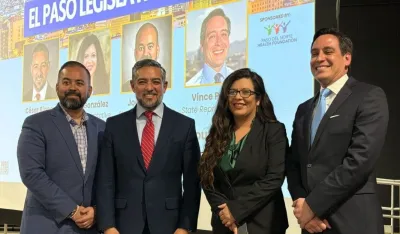
Public school funding, access to health care and issues related to immigration and the border are some of the key topics El Paso lawmakers hope to address during the 89th session of the Texas Legislature.
State Sen. César Blanco and state Reps. Mary González, Joe Moody and Vince Perez participated in a panel discussion Wednesday at the El Paso Community College Administrative Services Center to talk about their priorities for the session. State Reps. Claudia Ordaz and Eddie Morales were unable to attend.
The discussion was moderated by El Paso Matters founder and CEO Robert Moore and sponsored by the Paso del Norte Health Foundation.
The Texas Legislature meets every other year. The coming 89th session convenes Tuesday, Jan. 14. State Comptroller Glenn Hegar has projected the state will have a $20 billion surplus going into the session.
School vouchers
With both the Texas House and Senate being controlled by Republicans, much of El Paso’s Democratic lawmakers’ efforts will go toward staving off conservative-led initiatives, including creating education savings accounts — a voucher-like program that allows parents to use state funds to pay for private school.
In 2023, Republican lawmakers and Gov. Greg Abbott attempted to pass similar legislation, tying public education funding increases to the same bill. Voucher legislation passed the Senate but failed to make it through the House due to Democrats and a coalition of rural Republicans who opposed the program.
Critics of the voucher-like program have argued that it will siphon tax dollars away from public schools, many of which are already under financial strain, and will only benefit high-income families with children in private schools.
“This is just a big tax giveaway to corporations and a big tax subsidy for folks who are already in private school. What you’re going to see a lot of corporate schools pop up, these fly-by schools that are going to coincidentally charge the same tuition that the state of Texas is giving folks. And you’re going to have all these random schools that are going to have very low standards (and) low accountability,” Perez said.
After a couple of House seats flipped and a handful of anti-voucher Republicans either retired or were ousted during the November election, Abbott boasted on X — formerly Twitter — that he had enough votes in the lower chamber to pass the legislation.
Some El Paso lawmakers said the outcome may depend on whether the program is limited to low-income families.
“I think when Abbott says he thinks he has the votes to pass it, the math looks like he does,” Moody said. “If it’s universal, I think that number starts to shift this way. If it starts to winnow down and limit and maybe certain populations, then maybe you get more votes that direction.”
González said she expects a repeat of the last Legislature, which was called back for a historic fourth special session in an attempt to get approval on the program.
“Maybe we do pass something. Will the lieutenant governor think that’s far enough? Will the governor think that’s far enough? Are we all just going to be in a stalemate because the leadership can agree on what vouchers or education savings accounts look like?” González said.
Public school funding
As schools throughout Texas deal with budget shortfalls, some lawmakers have suggested changing the formula used to fund public schools.
Currently, the state gives school district’s a basic allotment based on student attendance – $6,160 per student, which has not been changed since 2019.
Blanco hopes to change the formula so it is based on student enrollment.
“If kids are sick and they are out of school, the state doesn’t give the school money for the kid that’s out for that day, whereas in enrollment (based funding) the school district knows exactly what the state’s going to give them for that school year. It’s easier to budget and makes things a lot more efficient,” Blanco said.
Others like González want to implement legislation that would automatically increase the basic allotment to adjust for inflation.
Perez said he wants to create incentives for people who move to neighborhoods within a school district with shrinking enrollment such as the El Paso Independent School District to help it regain funding.
“I would like to see the taxing entities come together where they provide tax abatements, perhaps for a period of 10 years, to families who come in and rehabilitate homes in aging neighborhoods,” Perez said.