
El Paso health director Vinny Taneja tackles staffing, funding challenges


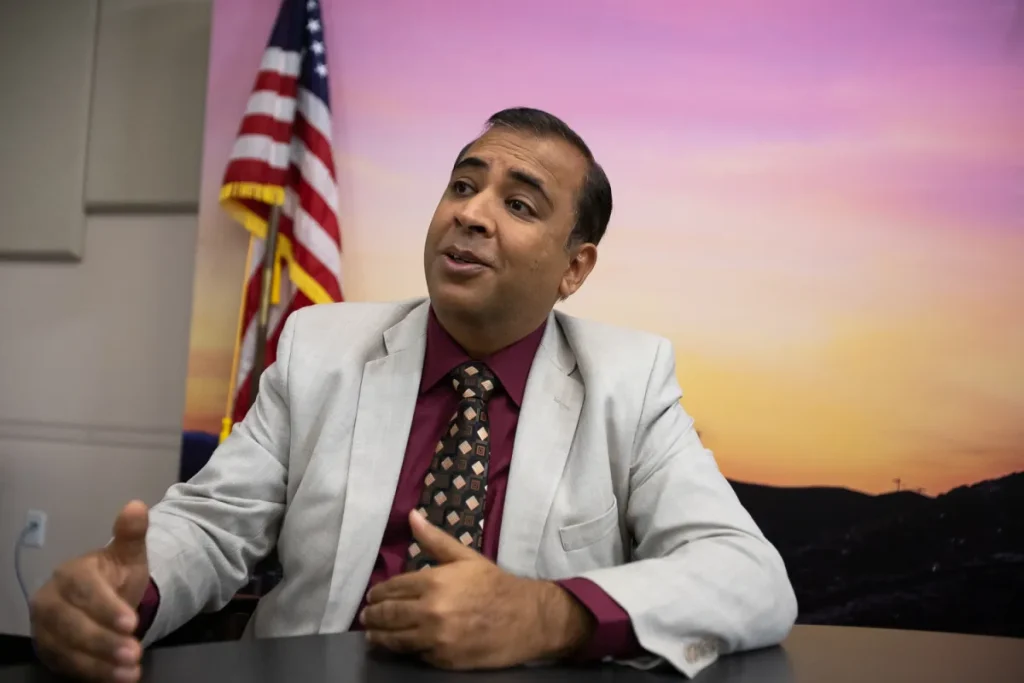
Six months into his new job as the El Paso director of public health, Dr. Veerinder “Vinny” Taneja is focused on improving low morale, increasing funding and filling job vacancies.
These are issues troubling local health departments across the country, he said. A robust public health department is key if the city wants to expand free and low-cost services to a community with deep health disparities and large uninsured population – all while facing an expected decrease in federal and state funding.
“You’re going to see some announcement come in the next couple months about some investments the city made for us in terms of facilities and other operations that we can roll out in the community,” Taneja said without providing details.
His more than 20 years in public health have given him experience navigating the cyclical ups and downs of public health funding, Taneja said. With funding on the downward trend, his team is exploring more external revenue sources to hire and retain staff.
El Paso employs the equivalent of more than 260 full-time public health employees as of January, according to a city report. The department has a budget this fiscal year of $18.6 million, more than half of which comes from grants.
Taneja took helm of the El Paso Department of Public Health on Aug. 5 and receives an annual salary of $180,000, according to an offer letter from the city. He reports to Deputy City Manager Mario D’Agostino. Prior to joining the city, Taneja served as Tarrant County public health director from September 2014 until his contentious departure in February 2024.
The public health department went more than two years without a permanent director before Taneja’s hiring. During that time, Dr. Hector Ocaranza led as the interim director in addition to his jobs as city-county health authority and as a private practice pediatrician in New Mexico.
As the director, Taneja oversees the administration of the city’s public health services, community clinics and grant-funded programs. The department’s duties include:
- communicating the spread of infectious diseases.
- tracking health trends.
- running immunization campaigns.
- supporting the nutritional needs of pregnant and postpartum women.
- conducting food inspections.
- providing preventive care, such as STI testing.
Boosting employee morale
Local health departments are still recovering from burnout, backlash and turnover during the politicized pandemic, which exacerbated already existing shortages in staffing and services.
The majority of the 200 city health employees who participated in an anonymous, departmentwide survey in 2024 answered they were at least somewhat satisfied with their job, according to the findings report obtained by El Paso Matters. Comments about health leadership, mentioned the most in responses, were largely negative, with 43% of respondents saying they did not feel safe to speak up at work.
Ocaranza, who led the department at the time, remains a part of the leadership team.
“It is important to view the answers in the context of how to address the significance of the answers and not to speculate reasons why,” Ocaranza said in an email provided by the city. “The goal is to create a safe and supportive working environment for employees, and to voice their concerns is essential to any successful organization.”
He and Taneja are focused on building a more collaborative work environment, Ocaranza said.
Taneja came to El Paso after receiving his own complaints from staff. He resigned Feb. 6, 2024, from Tarrant County after the Star-Telegram published findings from a human resources report, where more than a dozen current and former employees described a “toxic and hostile work environment” under the leadership of Taneja and deputy director of public health Angela Hagy, who left the department last year. Some of the complaints HR received were directed to Taneja. The county’s human resources department determined no laws had been broken.
Taneja attributed the complaints to the coronavirus pandemic creating a stressful environment, with waves of layoffs and hiring, that led to low morale.
“It was obviously very tough for most public health departments and people who work there because we were out there doing testing, we were out there doing vaccinations, long lines, people were under a lot of stress,” he said.
Taneja said he’s begun trying various ways to build communication and trust during the past six months in El Paso. He told employees he has an open-door policy, meaning people do not need to make an appointment to knock on his door.
He said he takes the time to visit the city’s clinics and shadow workers, such as joining restaurant inspections, to understand their working conditions. He said he is also working with the newsletter committee to communicate with the department the state of public health, funding cycles and new opportunities at work.
“I think a complaint was sometimes programs are so ingrained in responding to COVID or other things, that what’s happening in other parts of public health is not visible and it feels a little disjointed,” Taneja said.
Hiring and retention
Taneja and city leaders are also tasked with reducing the high number of vacancies.
About 30% of full-time equivalent jobs in the health department are unfilled, according to a city vacancy report. Some of the health department’s vacancies were jobs created from COVID-19-related funding, which the city will eliminate, City Manager Dionne Mack told El Paso Matters in a Jan. 31 meeting.
The COVID-19 Relief Fund makes up 47 unfilled jobs, from licensed vocational nurses to patient navigators, that will eventually be eliminated, according to a list shared by the city. Two-thirds of the remaining vacancies are jobs funded by public health grants, such as WIC clinical assistants and breastfeeding counselors.
Between January 2020 and Taneja’s start date, there was a turnover of more than 300 employees in the health department, according to records obtained by El Paso Matters. About 10% of the departures were retirements while the majority came from resignations and quitting without notice.
The aging workforce has been a topic in the public health community for more than a decade, Taneja said. Some people delayed their retirement to see the country through the pandemic, while younger workers have ventured off to private sector health care with more lucrative pay, he said.
Hiring public health nurses is a challenge, especially when traveling nurses can make higher salaries, Taneja said. Tarrant County would schedule 25 people for interviews and only two would show up, he recalled.
At El Paso, the starting pay range for an entry-level nurse is about $80,000 to $137,000, while the salary for a patient care technician ranges from $33,000 to $54,000, according to job listings posted on the city’s careers website.
Taneja sits on an advisory committee for the master of public health program at the University of Texas at El Paso. He said partnering with colleges can help the department recruit not only degreed professionals, but also vocationally trained workers, such as breastfeeding counselors who do not require a college degree.
One of Taneja’s goals is to also bring stability to leadership. El Paso’s health department saw three different directors during the first years of the pandemic: Robert Resendes, who resigned; Angela Mora, who retired; and then Ocaranza.
Taneja resigned from his own position as director at Tarrant County Public Health after receiving a termination letter from the county administrator, who accused Taneja of engaging in deceptive actions regarding the HIV contact tracing program and billing amount for COVID-19 testing.
“So, these things happen when you get new leadership in places, sometimes they want different department-level leaders and that’s exactly what was happening,” Taneja said. “But that is part and parcel of being in a public health setting or governmental jobs at a high level when administration changes.”
Diversifying funding
The El Paso health department’s budget has declined in the last three years, according to the city’s budget books – more significantly when accounting for inflation. A little less than half of the department’s budget comes from the city’s general fund, the bulk of which is generated from property taxes, sales taxes and fees. Other funding comes from federal and state grants and other sources.
The health department will need to diversify its sources of non-general funding to retain workers and expand services, Taneja said. He projects a financing shortage, which Taneja said he has already discussed with staff in a department-wide meeting.
Mack, who once oversaw the public health department as deputy city manager, said that since programs such as WIC rely on the federal government, “you don’t know where those hits might come.”
“You always had this crazy lag with them because they have grant funding and so we always had a really difficult time filling some of those positions,” Mack said. “When the grant was on towards the end, people start looking for new jobs, and then you can’t hire people in those positions.”
President Donald Trump’s executive order last month to freeze federal grants – which the administration rescinded two days later – caused a flurry of phone calls and meetings, Taneja said.
While programs such as the federal Public Health Infrastructure Grant, which funded the 2024 employee survey, support staffing needs, areas including chronic disease prevention in El Paso remain poorly funded, he said.